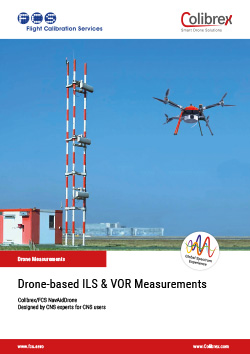
ILS Inspection with the NavAidDrone
Perform airborne ILS measurements — without a flight inspection aircraft
Drone-based inspection combines the strengths of flight inspection and ground measurement by providing full ICAO-compliant parameter evaluation together with high-resolution, flexible and repeatable measurement capability.
Capability Matrix
Flight Inspection | NavAidDrone Inspection | Ground Inspection |
Full system validation
| Flexible airborne signal-in-space measurement
| Essential system maintenance
|
Challenges:
| Key benefits:
| Limitations:
|
The NavAidDrone reduces reliance on flight inspection by enabling many airborne measurements to be performed more efficiently from a drone platform | ||
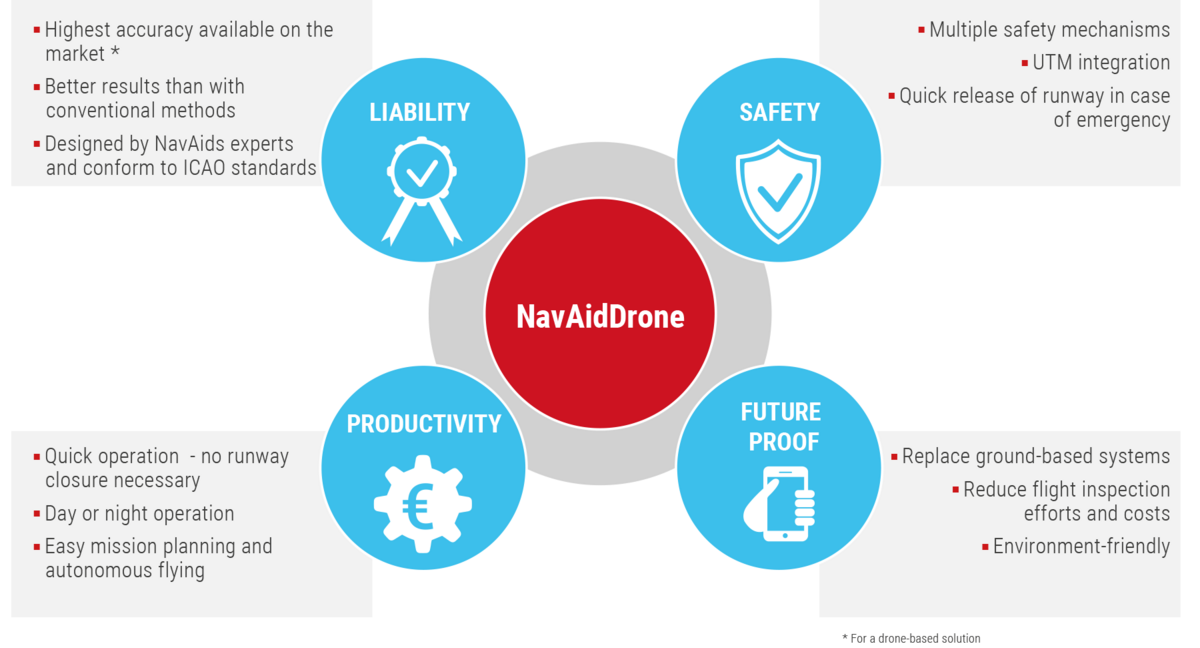
Structured Drone Measurement Profiles for ILS
The NavAidDrone executes a comprehensive set of measurement profiles equivalent to key elements of flight inspection procedures:
Glide Path Evaluation
- Vertical beam scans to determine path width, clearance, and monitor thresholds
- Vertical slice measurements to analyze 90 Hz / 150 Hz dominance and sector limits
- Stabilized approach flights to determine glide path angle and signal structure
Localizer Clearance and Course Width
- Constant-radius arc flights to evaluate clearance behaviour and course width
- Measurement of clearance slopes and minimum clearance levels across operational sectors
Localizer Course Structure
- Centerline approach profiles to determine course alignment and signal structure (Z1)
- Offset approaches to evaluate signal structure in outer sectors (Z2 / Z3)
Flexible Operational Profiles
- Adapted measurement profiles for partial runway availability or airspace constraints
These profiles replicate the geometry and logic of flight inspection, making the results directly usable for correlation and operational decision-making.
A Better Alternative to Traditional Glide Path Measurements
The advantages of drone-based measurement are particularly evident for glide path antenna adjustment and periodic inspection.
Traditional telescopic mast measurements are limited by height and must be installed close to the antenna—often requiring runway closure and significant operational constraints.
The NavAidDrone, in contrast:
- Measures directly within the 3° approach path, where the signal is fully developed
- Operates well away from the runway, avoiding operational disruption
- Completes a typical measurement in approximately 3 minutes
- Can be deployed between aircraft movements
This results in more representative data, faster execution, and minimal impact on airport operations.
Localizer Measurements Without Ground Constraints
For Localizer systems, the NavAidDrone enables fully airborne measurement of clearance, course width, and signal structure.
Using arc flights and approach profiles, the system:
- Eliminates the need for service roads or ground-based measurement setups
- Provides continuous signal-in-space evaluation across operational sectors
Enables efficient analysis of monitor behaviour and transmitter switching
The NavAidDrone can streamline ILS inspection and commissioning
Key benefits of our solution
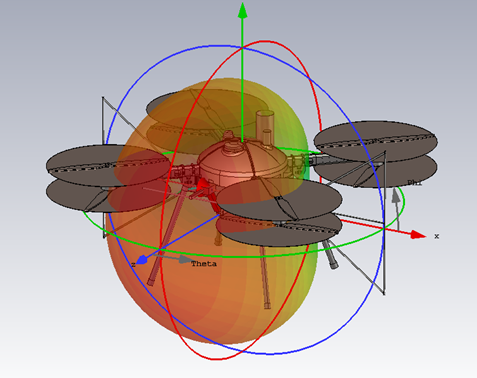
What’s special about NavAidDrone and different from other solutions?
Designed for high performance and easy of use
As the inspection of critical systems such as ILS requires the highest level of professionalism, accuracy and reliability, we decided to design the NavAidDrone as an integrated system together with the NavAids experts FCS Flight Calibration Services. FCS as highly recognized provider of flight inspection of navigational aids contributed with their valuable expertise and experience.
The receiver technology integrated in the NavAidDrone system was designed in cooperation with and approved by PTB, the German Federal Institute of Physics and Technology, Germany´s authority when it comes to accurate and traceable measurements.
Unlike other concepts available on the market, NavAidDrone is “one measurement device”, consisting of a complete system including the receiver and specially designed antennas.
Typical workflow of an ILS measurement
The unique integrated software manages all the operations in an automated automized, precise and reproducable way
Who is already using the NavAidDrone?
Learn more about our NavAidDrone Measurement Projects at the Project References Page
Downloads